2025 Year In Review

***You are viewing this report as a web page.  To translate, please select your desired language from the drop down in the top right.***

2025: Year in Review

Jim Mueller

Executive Director

January 21, 2026


Dedication

This report is dedicated to the memory of Howard Tribucher, Water Repairer 2, Ron Meola, Assistant Maintenance Supervisor, and Lee-Roy Jones, Water Meter Repairer who passed away in 2025.


Message from Executive Director, Jim Mueller

Jim-Mueller-Executive-Director-PVWCAs I conclude my fourth year at the Passaic Valley Water Commission, I am proud of the progress we have made and mindful of the responsibility we carry as stewards of one of the region’s most critical public assets. This annual review reflects on the work accomplished over the past year and situates it within a longer-term strategy to modernize our system, strengthen organizational capacity, and improve service for the communities we serve—today and for decades to come.

Building on the legacy of innovation and progress established by prior leadership, PVWC has continued to move from stabilization toward transformation. We have deliberately strengthened our internal capabilities by staffing up critical operational functions and insourcing work that had gradually been outsourced over time. This shift has improved responsiveness, institutional knowledge, and long-term cost control, while creating momentum that continues to build across the organization.

At the same time, we have launched an aggressive capital program to address one of the oldest water distribution systems in the country. That program has accelerated significantly and is now entering a construction-intensive phase that will define the next five to ten years. In parallel, we are investing strategically in treatment plant process upgrades and advancing our first major conversion of an open-air drinking water reservoir—the Levine Reservoir in Paterson—into covered storage. These efforts represent tangible progress toward improving water quality, system resilience, and regulatory compliance.

Looking ahead, our planning efforts continue to address complex and competing priorities, including a major PFAS treatment upgrade at the Little Falls Water Treatment Plant, future covered storage projects at the Great Notch and New Street reservoirs, and other state-of-good-repair needs throughout the system. While these decisions require significant time, analysis, and resources, making the right choices now will position PVWC for a sustainable future for generations. The leadership and support of the PVWC Board of Commissioners have been instrumental in allowing us to look boldly decades ahead while charting a practical and disciplined path forward from the near term to the long term.

Our emergency response capability remains a defining strength of the organization. The dedication and skill of our operations, maintenance, engineering, and IT staff—augmented by qualified contractors where needed—have enabled PVWC to respond effectively to a wide range of challenges, from field emergencies to cyber incidents, while continuing to serve the homes and businesses that depend on us. These experiences have further strengthened our preparedness and reinforced the professionalism and dependability of our workforce.

I am also grateful for the partnership and support of our owner cities and retail communities, whose leadership and collaboration are essential to our success. In particular, Mayor Andre Sayegh, Mayor Hector Lora, and Mayor Raymond Grabowski have played integral roles in advancing modernization efforts and improving customer service. At the state level, Congresswoman Nellie Pou; State Senators Benjie Wimberley, Paul Sarlo, and Teresa Ruiz; Assembly members Gary Schaer, Clinton Calabrese, Alixon Collazos-Gill, Rosaura Bagolie and Al Abdelaziz; and NJDEP Commissioner Shawn LaTourette have been strong advocates—especially during the Paterson water emergency and in supporting lead service line replacement and other critical funding initiatives. Finally, I deeply appreciate Governor-Elect Mikie Sherrill naming me to be part of her  Interdisciplinary Transition Team Advisory Task Force to represent PVWC and the water industry and provide input on policy issues for the incoming administration.

Most importantly, I thank the PVWC employees—many of whom live in the communities we serve—who show up every day committed to our mission, vision, and core values. I am proud to work alongside you. Our ratepayers are fortunate to have such a dedicated team working on their behalf.

As outlined in this report, our three-pronged strategy remains the foundation of our work: invest in our infrastructure, invest in our employees, and invest in the communities we serve. The progress summarized here reflects that strategy in action and sets the stage for the work ahead.

PVWC Proud.


Jim Mueller

Executive Director


PVWC Organizational Structure

PVWC is governed by a Board of Commissioners with the following responsibilities, as detailed in the Articles of Agreement: defining the job duties and compensation of PVWC staff, setting water rates, signing and executing all contracts, approving all money disbursements, and developing and enforcing Commission policies. The Board of Commissioners is a seven (7) member Board with two (2) Commissioners appointed from Clifton and Passaic respectively, and three (3) from Paterson. Reporting directly to Board are the Executive Director; General Counsel; and Board Secretary. The 2025 composition of the Board and the reporting structure are detailed below.

2025 Board of Commissioners

Owner City

Mayor

Commissioners

Paterson

Andre Sayegh

Ruby N. Cotton

Carmen DePadua

Jeff Levine

Passaic

Hector Lora

Rigoberto “Rigo” Sanchez

Ronald Van Rensalier

Clifton

Raymond Grabowski

Gerald Friend

Deb Rizzi


2025 Reporting Structure

commissioner-chart-pics-and-titles-2025.jpg

PVWC is also a partial owner (37.75%) of the NJDWSC. That entity was created by statute in 1916, with the authorization to “develop, acquire, and operate a water supply system for use by any municipality in the “North Jersey District” defined as the 12 northernmost counties of the State of New Jersey”. In 2025 PVWC paid $10.5M to the NJDWSC to fund the annual budget, proportional to PVWC’s ownership share.


Table of Organization

One of the challenges facing many utilities including PVWC, is an aging workforce facing retirement leaving succession planning gaps in skills and experience. To begin to address this issue, we continue instituting a performance management program for all staff; hiring qualified individuals; measuring productivity and promoting capable people to supervisory positions. As of January 2025, PVWC is staffed by 247 full-time employees with 69% serving in operational or maintenance roles and the balance serving in administrative roles. See below for the PVWC Administration organization chart.

org chart picts and titles.png

Key Personnel Changes

In 2025 the Board of Commissioners approved 29 promotions, 19 new hires as well as six (6) new titles for the following positions: Electrician Helper, Apprentice Electrician, Equipment Operator, Network Administrator 1, Electronic System Technician 1, and Chief Chemist Water Analysis.


Promotional Highlights:

  • Juan Bosque, Anthony Marino, and Agner Upia-Manzueta, Pumping Station Operators promoted to Sr. Pumping Station Operators
  • Eugene DePersio, Water Treatment Operator promoted to Sr. Water Treatment Operator
  • Javier Hendricks, Sr. Engineer promoted to Principal Engineer
  • Mike Nigro, Sr. Maintenance Repairer Welder promoted to Supervising Water Treatment Repairer
  • Eleven (11) Laborers promoted to Equipment Operator; Sr. Maintenance Repairer Mason; or Meter Worker/Water Meter Repairer.
  • The other 12 promotions crossed multiple departments including Distribution, Engineering, Laboratory, and Maintenance.


New Hire Highlights:

  • John Byrne, Chief Pumping Station Operator, T3/W3 – joined PVWC in July 2025 to oversee operations in the Pumping Station.


Finances and Funding

Revenues 2024-2025.png

 Preliminarily, as of year-end for 2025 total revenue collected was $134.6M with almost half generated by retail metered service. One major change in 2025 was the increase in Misc. Revenue which went up by almost $6M. This was mainly due to settlements related to the class action PFAS lawsuits against major manufacturers that PVWC is a party to. All numbers will be finalized by March once all quarterly bills are reconciled through December 2025.

Expenses 2024-2025.png Expenses for 2025 total $111.7M through Dec. 31st and are distributed across four (4) general categories as illustrated by the chart below. The largest expense category in 2025 was Other Than Personnel Services (OTPS) which was $32.8M, a $5.7M increase from 2024. The top four (4) categories of OTPS expenses are chemicals, electricity, residuals management and outside contractors totaling almost $22M. Administrative and General Expenses include the annual payment to the NJDWSC of $10.5M. It also includes depreciation, bond reserve interest and bond interest expense. The third highest is personnel services (PS) and last is insurance and taxes. The surplus cash is used to pay for smaller capital purchases as well as increase operating cash on hand and reserves to maintain our high credit rating of Aa3. As can be seen in the graph below, water rates have been flat or trending down since 2010 which also coincides with the general decrease in PVWC’s debt profile until 2022. As a result of PVWC’s capital needs, the PVWC Board of Commissioners approved a 5-year budget with associated rate increases of 5.9% annually starting in 2024. Since 2024, many other water utilities in Northern NJ have raised water rates significantly due to aging infrastructure, more stringent regulations for PFAS treatment, and rising operating costs. Private companies have imposed increases between $5-8/month initially and then targeting smaller annual increases of 3%. For 2026, the Board revisited water rates and reduced the 2026 rate increase to 3.9% ($1.89/month average increase for residential) for retail customers and 4.3% for wholesale customers.


Debt Profile and Water Rates

Debt Profile and Water Rates.png


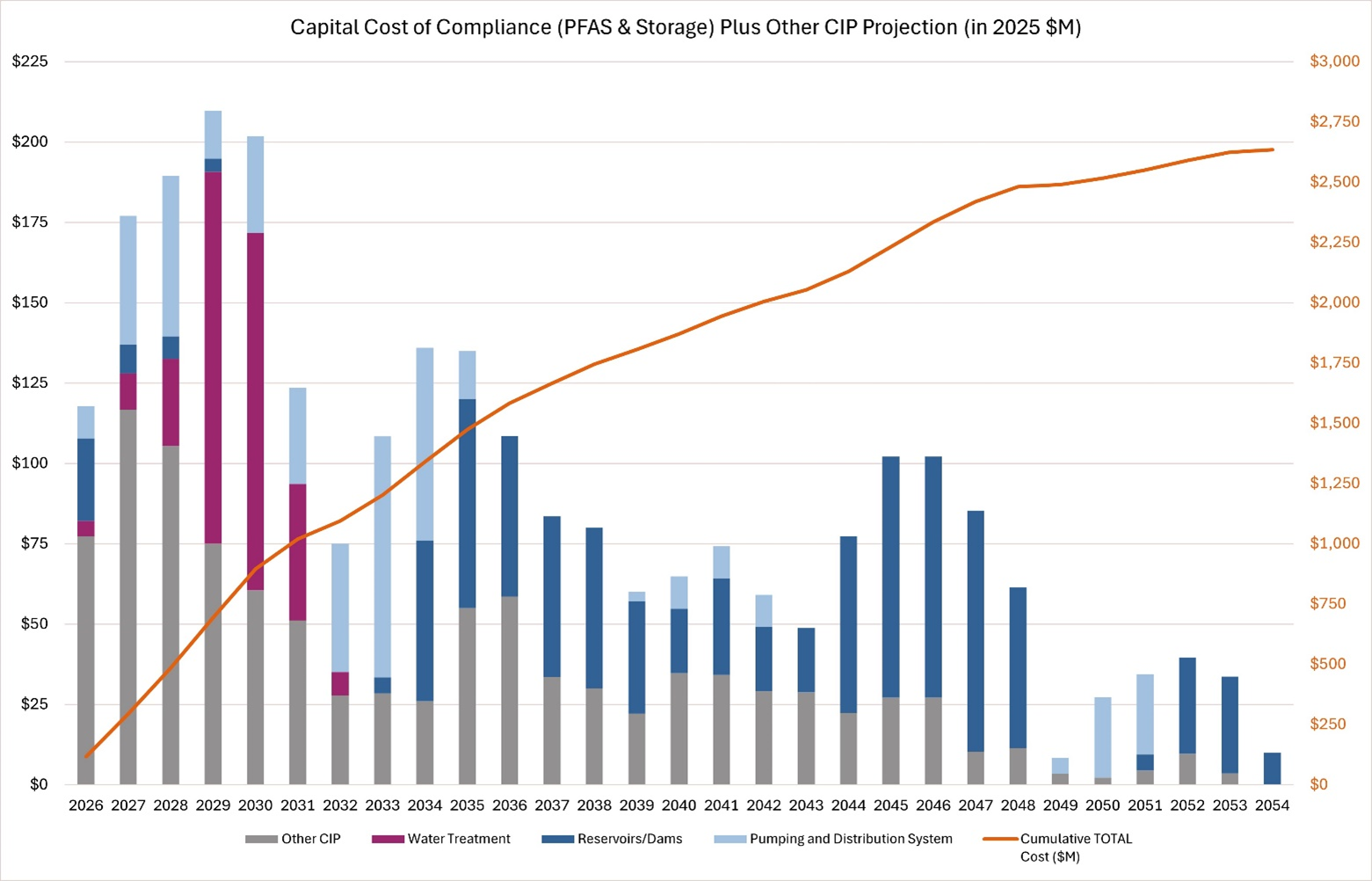
In the Capital Program section of this report there is a conceptual forecast of capital needs out to 2054 covering PFAS treatment, reservoir storage projects, transmission and water main upgrades and other capital needs. Funding considerations will be a key factor in decision-making, and phasing work in a practical way will be a major focus. Currently the conceptual cumulative capital forecast over the next 30 years is approaching $3B (in 2025 $).

Funding

The Executive Director submitted the funding position paper entitled “Addressing Inequities in the New Jersey Drinking Water State Revolving Fund for Large Water Systems” to NJDEP on June 6, 2024. Some of the recommendations in the paper were adopted by NJDEP for SFY25 such as increasing principal loan forgiveness for the Levine Reservoir to $10M (up from $2M in SFY24); water meter replacement principal forgiveness up to $7M; and an additional $4M in principal loan forgiveness for other system improvement projects.  The cumulative recommendations in the paper would double the annual principal forgiveness available to large water systems who rank highly on affordability criteria from $32M to $65M. Given the competing needs of regulatory mandates, state-of-good-repair requirements due to system condition and age, and increasing demands from development as well as climate change impacts, the proposed increase in funding opportunities is warranted. We continue to work closely with NJDEP to further discuss options to fund the ongoing PVWC capital improvement program. In 2025, the Federal government has slashed funding for the State Revolving Fund (SRF) which is estimated to be a $150M reduction annually for the NJ I-Bank. Project funding impacts may manifest in late 2026/early 2027 unless alternative funding sources are identified or funding levels are restored.  

Past Due Balances

There are over 77,000 residential, commercial, industrial and fireline accounts with PVWC and the majority of accounts are billed quarterly. Starting in 2020, during the Covid pandemic, utilities were prohibitied from turning off residential customers for non-payment of bills.  This moratorium was lifted during the Summer of 2022. During the moratorium PVWC delinquent accounts almost doubled to $14M compared to the pre-Covid balance. To assist customers PVWC agreed to participate in the Low Income Household Water Assistance Program (LIHWAP) for those who met State eligibility requirements and were approved by the NJ Department of Community Affairs (DCA). The DCA started making payments to PVWC in September 2022 and the last payment was made in June 2024. A total of 297 customers participated with total LIHWAP payments equaling $427,365 towards past due balances. In April 2025 PVWC entered the SHARES program where eligible customers can receive up to $200 in water bill assistance. Through December 2025 PVWC has received $22,206 across 125 accounts through the Shares program.

2025 Year-End Past Due Balances

 (Net = Gross – Payment Plans)

Net Delinquent.png


Past Due Balance Trend.png


Annually, the State Winter Termination Program prohibits residential shut-offs for eligible customers between Nov 15th – March 15th each year with specific rule changes introduced in 2023. On September 24, 2025 a State law was passed requiring a Summer termination program prohibiting residential shutoffs by utilities from June 15th – August 31st each year.  This will take effect in Summer 2026.  We encourage all customers to continue to make payments and/or enter into interest free payment plans so their debt does not accumulate and compound. In March 2024, the net past due balances peaked at over $14M and has trended down significantly since then due to the success of account shutoffs as well as PVWC Customer Service outreach directly to account holders.  As of the end of 2025 there were gross past due balances totaling $10.7M with 168 of these accounts on interest free payment plans totaling over $193,000. The net delinquent amount is $10.5M as of the end of 2025.


Emergency Response

Given the age and interconnectedness with other jurisdictions of PVWC’s system, as well as climate change impacts causing more frequent severe weather, the need for robust emergency response and organizational adaptiveness is critical. This applies to both unplanned infrastructure outages and weather events as well as planned outages to support maintenance and construction activities. PVWC’s response capability relies on the skill and expertise of our in-house staff as well as contractor support for larger events or extremely high volumes of work.  Under PVWC’s emergency response contract with JF Creamer, there were 35 incidents requiring contractor response totaling $9.5M that were completed in 2025.  Below is a summary of various emergency response events that include both in-house and contractor responses during 2025.


January/February

ER jan-feb.pngThere were 52 water main breaks in January 2025 according to the Distribution Dept work-to-do tracking which was more than double the number of breaks observed in January 2024. In February there were another 16 breaks requiring emergency response. In-house crews addressed 94% of these breaks working around the clock in many instances. These breaks were caused due to the excessive cold weather throughout with some temperature volatility above freezing and then dipping below. The reason for this is the metal pipes contract in cold weather and the ground expands due to freezing water which can increase the pressure on the pipe by up to a factor of 10. In addition, many of the pipes in our system are over 100 years old or made of unlined cast iron which is more prone to breaks. There is a major capital program that will be rolling out starting in 2026 to begin to systemically address problem areas in the Distribution system. A more detailed description of the planned work is included under the Capital Program section of this report.


April

ER april.png

In response to the drought warning issued by NJ DEP in November 2024, PVWC Maintenance successfully completed clean-out of the intake off the Pompton River that feeds the Jackson Ave PS to pump flow to the Point View reservoir as part of the drought management plan. In addition, air valves and vents were evaluated along the Wanaque South pipeline where flow from Point View would be sent in a drought emergency. Work was completed to replace inoperative valves.  Preventative maintenance work orders will be programmed into CMMS to ensure quarterly, semi-annual or annual tasks are identified and tracked to stay on top of this work.  Thanks to Joe Aldighieri and Mike Nigro for leading the effort.


August

ER august 01.png

On Friday, August 8th at 6 AM, a major leak was detected at Great Falls that disrupted two major pipelines feeding a majority of Paterson, Prospect Park, N. Haledon and Haledon that put these towns in a boil water advisory (24” main and a 30” water main disruptions).

  • PVWC staff and contractors worked around the clock to isolate the leak and repair the problem. Due to the site location and age of infrastructure, access to the pipes was severely limited. As a result, water service was disrupted to many areas of Paterson and Prospect Park as well as N. Haledon and Haledon particularly in higher lying locations. I am immensely proud of our dedicated staff in Distribution, Engineering, Customer Service, Pumping, Maintenance, Communications, IT and Lab/ Purification that we began restoring pressure and water service to areas that were without water on August 14th by isolating and redirecting flow through the existing 24” line.  New pipes were installed on the 24” (300 LF) and 30” (500LF) lines and new 24” and 30” valves were also installed. The new 30” pipe was put back into service on August 17th and the new 24” pipe was put back into service August 20thJF Creamer was our emergency contractor and Garrison was a subcontractor for the line stops. 
ER august 02.png
ER august 03.png

ER august 04.png

At its peak there were approximately 46,000 people west of the Passaic River, in Paterson and Prospect Park, without water and wholesale customers in Haledon and N. Haledon were impacted as well. There were almost 200,000 people under a boil water advisory at the peak. The advisories were lifted in phases depending on location. The first area advisory was lifted August 15th, the second August 31st and finally on Sept 2nd the boil water advisory was lifted for all areas.

A special thank you and recognition to all our PVWC colleagues, family and friends who live in the impacted areas and persevered while showing up to work every day to help restore service. 

Hinchcliffe Incident Response – Operational Support

To support our retail and wholesale communities during the August 8th incident response, PVWC worked side-by-side with Paterson, Prospect Park, Haledon and North Haledon to implement interim measures and attempt to provide water to the areas with no water service. Interim measures were deployed including temporary pumping from different gradients; around-the-clock water tankers to alleviate lack of pressure preventing flushing of toilets and showers; temporary interconnections with other water systems; initiation and support of water bottle distribution; and support for deployment of portable bathrooms and showers. PVWC was supported by adjoining water systems including water trucks and equipment (e.g. large valves) from Veolia and NJ American Water, and temporary interconnections with Hawthorne and Wayne. Special thanks to Joe Aldighieri for his tremendous work with the fire departments and OEM, Mike Nigro for his specialty welding expertise and fabricating fittings in the field, and Mike Marotta for spearheading the work on interim pumping, water distribution and temporary interconnections that provided relief to tens of thousands of people as well as the entire Distribution and Maintenance departments.

ER august Hinchcliffe.png

There were many external agencies that provided support to the City of Paterson and to PVWC – I appreciate all those that assisted and answered the call. To date PVWC has paid out $2,460,664 for these services. Most of these costs were associated with water tanker services 24 hours per day for over a week as well as water bottle distribution of almost 30,000 cases. There were also portable showers and bathrooms provided as well as police and state-wide fire department support. 


On Saturday, August 23rd there was a water main break on a different pipe (42” diameter) at Arch and N. 1st Street in  Paterson. The isolation of the line impacted residents of the Riverside section of Paterson and PVWC’s wholesale customer, the town of Fairlawn. Water service to Riverside and Fairlawn was restored by August 25th by installation of line stops closer to the leak which isolated the line to allow replacement work to progress. New 42” pipe (86 LF) was installed and a new 42” valve was installed at Amity Street about ½ mile away from the location of the break. The new pipe was put back into service on Sept 11th

ER august Arch and N 1st PA.png

NJDEP has approved two (2) emergency loans up to $3M for each location to fund the replacement construction work with 100% loan forgiveness. The final capital cost for the August 8th Hinchcliffe Stadium replacement of the 24” and 30” water mains is $3.5M. The cost for Arch and N. 1st 42” water main replacement is $2M.


ER august McBride WP.png

On August 24, 2025 a leak was discovered on the 42" transmission main running under McBride Ave in Woodland Park on the New Street gradient and a repair was effectuated that drastically reduced the leak. However, due to the age and condition of the 120-140-year-old pipe, water was continuing to seep out of the repaired area. After test pitting along McBride Ave, areas of competent pipe were located on either end of the leaking segment and 200'of pipe were replaced starting October 15th under the existing emergency contract with JF Creamer. The scope of the project included 200' of new 42" pipe, a new 42" valve, line stops, traffic control, temporary bypass piping to maintain flow, and labor including 24/7 shifts for 3-4 days while the old pipe is removed and new pipe placed. 


September

ER sept Bunker Hill.png

On September 25th JF Creamer performed a spot repair on the 120–140-year-old 42” transmission main in the Bunker Hill section of Paterson on the Levine gradient due to a leak in the street. This same location was repaired 10-15 years ago. A 150’ segment of water main will be replaced at this location under the emergency contract with JF Creamer once the Woodland Park work is completed. This work is not expected to require a bypass or extensive traffic control. 


October

ER october McBride WP.png

Installation of 200’ of new 42” pipe on McBride Ave was completed during the weekend of October 17th. The construction necessitated a bypass pipeline to maintain flow to customers. The new pipe was placed back into service after being disinfected and passing coliform testing during the week ending October 24th. The cost of this work was $1.7M.


November

 The contractor completed replacement of approximately 135 linear feet of old main in the Bunker Hill section of Paterson on Wood and N. 5th with new 42” ductile iron pipe (DIP) along with a new 42” butterfly valve and new access tee. Isolating the line proved extremely difficult with multiple line stop locations attempted until finally the main was isolated. Replacement work was initiated on November 5th and completed on November 13th. The current cost estimate for this work is $0.9M and we are awaiting the final invoice.


December

Starting in early December, Levine Reservoir was taken out of service to start draining and preparing for construction of the dividing weir to segment the reservoir with a smaller storage capacity to be back online by February 2026. Storage tank construction will commence on the balance of the site after the dividing weir is completed. Since the reservoir has been out of service we have seen spikes in pressures in the Levine gradient and staff in pumping and distribution have been working to address these issues.

ER december.png

On December 15thth there was a residual process upset at the Little Falls treatment plant due to a chemical dosing error. The situation was corrected however later that week on December 20th there were problems with blankets in the thickeners that necessitated cutting back on plant flow to 30 MGD so Maintenance could clean out the thickeners. This situation coincided with a reduction in flow from Wanaque because of the ongoing dry conditions with that reservoir being down by 30’. With the Levine Reservoir out of service since early December the filter plant flow was supposed to always be at 60-65 MGD. Fortunately, Wanaque was able to ramp up flows overnight and Maintenance did a great job expediting thickener cleaning to eliminate the blankets of solids. Normal plant operations resumed Monday, December 22nd and water quality issues associated with lower storage levels were mitigated as a result. Cleaning out the Thickeners twice a year is important to ensure normal operations throughout the year. 

From December 17th to 18th there were issues with low water pressure at the Prospect Park tank and in parts of Paterson west of the Passaic River. This was due to an error in pumping at the Great Falls pumping station that was under modified operations due to the Levine Reservoir being out of service. The situation was corrected in a matter of hours and pressures returned to normal with localized hydrant flushing performed as a precautionary measure.

On December 27th there was a plant shutdown due to a frozen valve impacting the ozone gas (GOX) system. Maintenance deployed a heater and wrapped the pipe in blankets to get the process restarted.

There were 31 water main breaks in December 2025 according to the Distribution Dept work-to-do tracking which was 72% higher than the breaks observed in December 2024. In-house crews addressed 87% of these breaks working around the clock in many instances. These breaks were caused due to the excessive cold weather throughout with some temperature volatility above freezing and then dipping below. The reason for this is the metal pipes contract in cold weather and the ground expands due to freezing water which can increase the pressure on the pipe by up to a factor of 10. In addition, many of the pipes in our system are over 100 years old or made of unlined cast iron which is more prone to breaks. There is a major capital program that will be rolling out starting in 2026 to begin to systemically address problem areas in the Distribution system.

Special thanks to the core PVWC Incident Response Team led by Mike Marotta, Joe Aldighieri, Pat Porcaro, Alex Wells, Mark Romain, and Wendy Simone as well as all PVWC staff in Purification, Pumping, Maintenance, Distribution and Engineering for their dedication and tireless work to respond to these emergency incidents. Their collective efforts around the clock mitigate disruptions to our customers and the communities we serve.

Additional thanks to all of our Customer Service staff led by Maria Malfa and Otilia Espino who field customer calls and provide updated information and direction as well as our Purchasing and Finance staff led by Lisa Bresemann, Lindsay Kelly, and Yitz Weiss who review billings and ensure proper documentation is provided to expedite payments to the contractors and business who support us.

ER group photo.png


Capital Program

PVWC’s capital assets span eight (8) retail areas and 23 wholesale areas serving a population of 800,000 people across 77,000 metered accounts. Key asset highlights include: 650 miles of transmission and water mains; an 80 million-gallon-per-day (MGD) central water treatment plant; 125 million gallons (MG) of usable storage in three (3) uncovered, finished water reservoirs; five (5) dams; and administrative office space for 247 current staff as well as storage facilities for equipment and material located in Clifton, Little Falls and Point View Reservoir. 
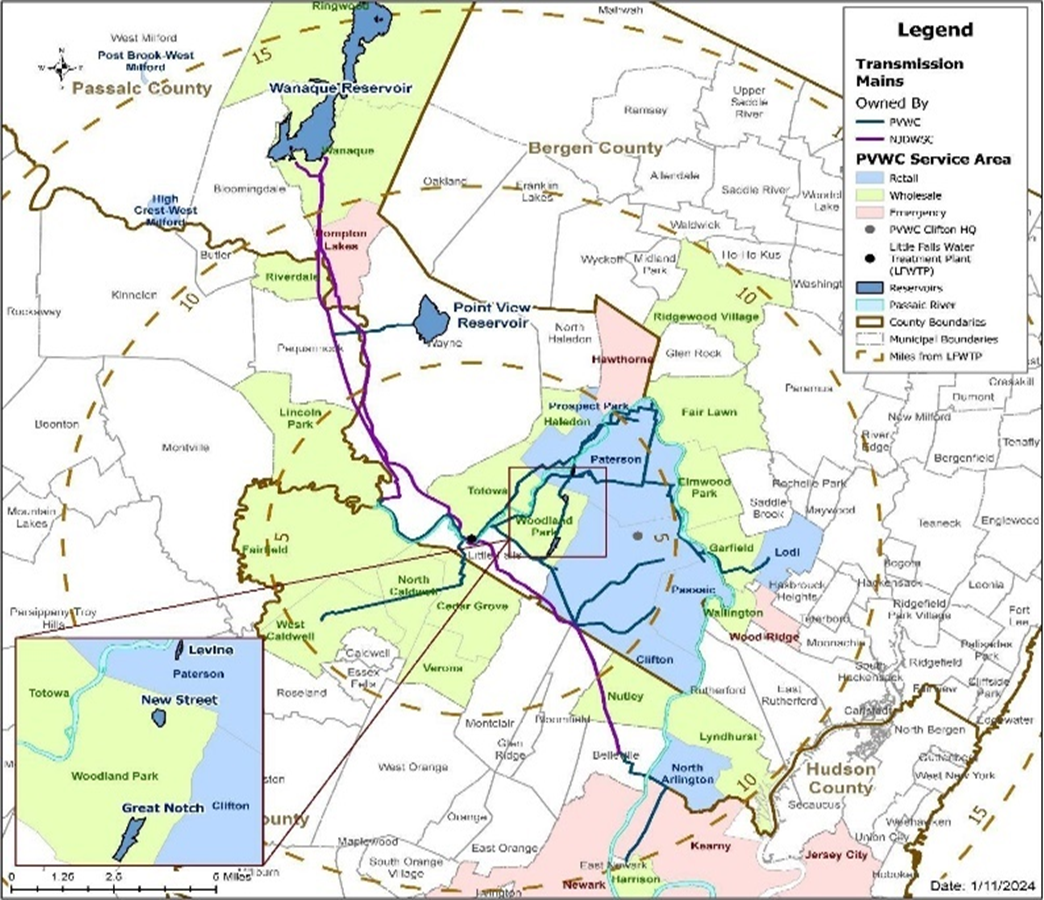
CP map.png


In 2025 the capital budget was $880M from 2025 - 2030 across the following categories of infrastructure investment:

  • Water Storage Program
  • LSLR/Material Procurement/ Vehicles/Meters/Buildings & Grounds
  • Transmission/Water Mains
  • Treatment and Pumping
  • Digital Transformation

Below are highlights of ongoing construction, design and planning projects related to the PVWC capital program.

Water Storage Program

Levine Reservoir

In May 2025 construction officially commenced on the installation of two (2) 2.5 MG storage tanks to replace the Levine reservoir for $42M.  Site preparation work commenced in June and in December draining of the reservoir commenced in advance of construction of the dividing wall. This wall will segment the site into a smaller open water reservoir that will be put back into service by February 2026 while the north side of the site is prepared for tank construction. 

 
CP Levine pre-construction.png
 CP Levine draining 12-2025.png


In addition, on October 17, 2025 upon detailed inspection of the inlet line to the reservoir it was found that 1,000 linear feet (LF) was in severely deteriorated condition and PVWC declared an emergency to address the issue. A $2.1M change order was approved to the Levine construction contract to provide “emergency services” for full pipe replacement of this section of pipe. Completion of the entire storage tank project is projected for May 2027.


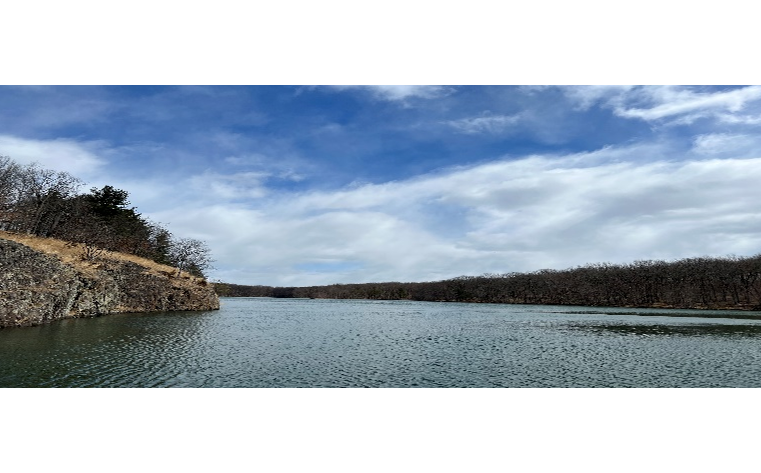
Great Notch and New Street Reservoirs – Distribution and Storage Planning
CP great notch.png

Great Notch and New Street reservoirs will have storage tanks constructed over a longer time period due to the scale and sequencing of the work and competing needs of other capital priorities for PFAS removal, upgrades to main pumping station, and investments needed in transmission mains and water mains to allow the system to operate normally when reservoirs are out of service. PVWC will need to submit a comprehensive planning report by May 1, 2028 to State and Federal regulators that will identify all necessary projects that will bring PVWC into compliance with the LT2 Rule. Based on the current unit cost of Levine of $8/gal and forecasting construction costs over time for Great Notch and New Street at $4-5/gal considering economies of scale + cost escalation, with targeted storage amounts of 75 and 60 MG respectively, total costs for these projects are in the $500-700M range.   We are currently working with Arcadis (Distribution and Storage Planning) and Black & Veatch (PFAS Planning) to develop a prioritized, integrated capital projection to address mandates and state-of-good-repair needs over the next 30 years. A preliminary projection is shown on the next page. This will be refined over time focusing on the next 5-10 years and then looking out over a longer 30-year horizon. Concepts being explored include sequencing work in phases to spread costs out over time, and phased PFAS treatment tailoring different technology to different parts of the system to match specific characteristics. 

Preliminary Conceptual Capital Forecast
CP Preliminary Conceptual Capital Forecast.png

The forecasted capital investments are front loaded over the next 5-10 years due to new regulatory requirements for PFAS as well as key infrastructure reaching the end of its useful life at the same time. This includes the 120 MGD main pumping station at the treatment plant and associated intake and outflow pipelines that are over 100 years old. Transmission main and water mains in the distribution system have similar capital needs across the 650-mile pipeline system with almost 60% approaching 100 years old and some nearing 140 years of age. In the mid-2030’s water storage mandates that have been deferred over the last decade begin implementation at Great Notch reservoir followed by New Street. These storage projects are being included in a new consent decree allowing a longer implementation timeframe in recognition of other competing needs for regulatory compliance and state-of-repair investments. Additional opportunities for principal loan forgiveness through the State Water Bank for the final LT2 projects, PFAS upgrades and pre-cursor projects will be a key factor in program execution.


Interim Water Quality Improvements

While covering the Great Notch and New Street reservoirs will be a long-term endeavor, PVWC performs extensive monitoring in the distribution system for pathogens and free chlorine to ensure the protection of public health. In 2025 there were 5,788 free chlorine samples taken with almost 98% of the results above the minimum requirement of 0.2 mg/l. There were only five (5) positive coliform samples for 2025, and the PVWC protocol is to flush and resample to make sure there is no threat to the public.


In addition, to pathogens, PVWC is investigating additional interim water quality improvement measures to reduce discolored water and nuisance algal blooms like MIB and Geosmin as well as iron and manganese that can impact taste, odor and color. Sampling is planned from November 2025 to March 2026 and pilot testing of various technologies is planned from March 2026 to September 2026 to address these issues.  Katherine McNaught, Manjistha Chattopadhyay and Wendy Simone in the PVWC Lab are working closely with Arcadis staff to identify technologies to deploy and pilot test in the coming months to minimize taste, odor and color issues.


Lead Service Line Replacement

Main System – Paterson, Clifton, Passaic, and Prospect Park

CP lead service replacemnt.png

The contract with CDM-Smith for CM and service line inspections began in the Spring 2022 and the construction contract with Pacific Construction (Contract 22-B-8) started in July 2022. The overall program is being funded through the State Water Bank with a loan amount of $37.6M which includes construction, CM, and administrative costs to PVWC. We have received a commitment of principal loan forgiveness ($27M) from the NJ I-Bank. The contract has expired as of October 31, 2025 and the long-term loan with principal forgiveness is expected to close by mid-2026.


CP lead service replacement trend.png

There are 212 customer-owned lead service locations that were non-responsive to repeated PVWC and contractor outreach. Currently PVWC’s inhouse distribution group is working on a plan to address these locations with support from other existing contracts as warranted.

Special thanks to Alex Wells, Supervising Engineer and her team for managing the contract to completion, Maria Malfa and her Customer Service  team for contacting customers, as well as Mike Marotta and the Distribution team for developing a plan to close out the last 212 non-responsive customer locations. In total there were 4,722 lead service lines replaced under this program for free for customers making the main system essentially lead-free from the street to the water meter at the home or business. 


North Arlington and Lodi

By 2031, the rest of the PVWC retail areas are required by NJDEP to have all customer-owned lead service lines removed by the company. In 2025 the forecasted budget for this work is $20M for Lodi and North Arlington. Work is forecasted to start in 2028 and be completed by 2031. This work may be accelerated if opportunities are identified to maximize principal loan forgiveness from the NJ Water Bank or if other become available. 


Material Procurement and Meters

Last year PVWC inhouse crews responded to 139 water main breaks with skill and efficiency. To support our crews we budget almost $10M annually for material procurement to ensure we have what we need to effectuate repairs cost-effectively and ensure water keeps flowing to our customers. There was also $23.3M budgeted through 2030 for meter replacements. In house meter crews replaced over 3,700 meters in 2025 and there were two construction contracts awarded in 2025 to install up to 20,000 meters in the Main System. These contracts will be funded with 100% principal loan forgiveness up to $7M. We will look to plan more proactive inhouse work to replace vulnerable pipes and meters more comprehensively that have reached the end of their useful life. Additional contracts will be advertised over time for meter replacements to leverage principal loan forgiveness opportunities.


Transmission and Water Mains

As stated previously there are 650 miles of transmission and water mains in the PVWC system and almost 60% are nearing 100 years old or greater with some nearing 140 years old. There have been limited capital investments to upgrade the distribution system for the last 50 years and due to the age of the system there is a need to catch-up on replacing these pipes. In 2025 there is almost $220M budgeted for transmission and water main upgrades in the PVWC retail areas through 2030. This includes stand-alone projects, emergency contracts, professional design and construction management services, and road paving for inhouse water main replacement work that we are ramping up over time.

During the response to the Hinchcliffe water emergency in August 800 LF of 30” and 24” pipelines were replaced on the hill adjacent to Hinchcliffe stadium. We will be bidding a project for Great Falls in Q1 2026 to upgrade the transmission mains at the top of the hill in Mary Ellen Kramer Park to modernize the pipelines on the whole site. This will be key to minimize risk and, combined with the 1000 LF being upgraded at Levine  reservoir, progress PVWC towards connecting key regional areas in PVWC’s system with new pipes. There remains about 1/4 mile of pipes between Levine and Great Falls that would need to be addressed in a successive phase when priorities and funding allows.

Below are maps illustrating the key stand-alone projects followed by a table listing key details of each project. These projects have been prioritized due to water main break history, criticality and coordination with planned work in Passaic County and the owner cities.

CP map 02.png


CP map 03.png


CP map Lodi.png
CP map NA.png


CP chart.png

Treatment and Pumping

PFAS Planning and Basis of Design

In April 2024, USEPA promulgated new regulations for PFAS water quality limits lowering the maximum level to four (4) parts per trillion (ppt). The Little Falls Treatment Plant will not comply with these new limits and PVWC entered a contract in September 2024 with Black & Veatch to develop a facility plan and basis of design as a pathway to compliance. All relevant data have been provided and a short-list of alternatives has been developed. The optimum path for the upgrade would be to maximize space down by the existing filters for new post-filter, gravity contactors with granular activated carbon (GAC) media.  However, there is not enough space to maintain current plan flows of 80MGD with that technology and as a result this alternative does not appear realistic. Moving the PFAS treatment process to the top of the treatment site, near the White House (see site plan below), where there is space seems to make the most sense. The need for modernization of the existing pumping station is a complicating factor, and this work is a priority due to the age of the pipes. 
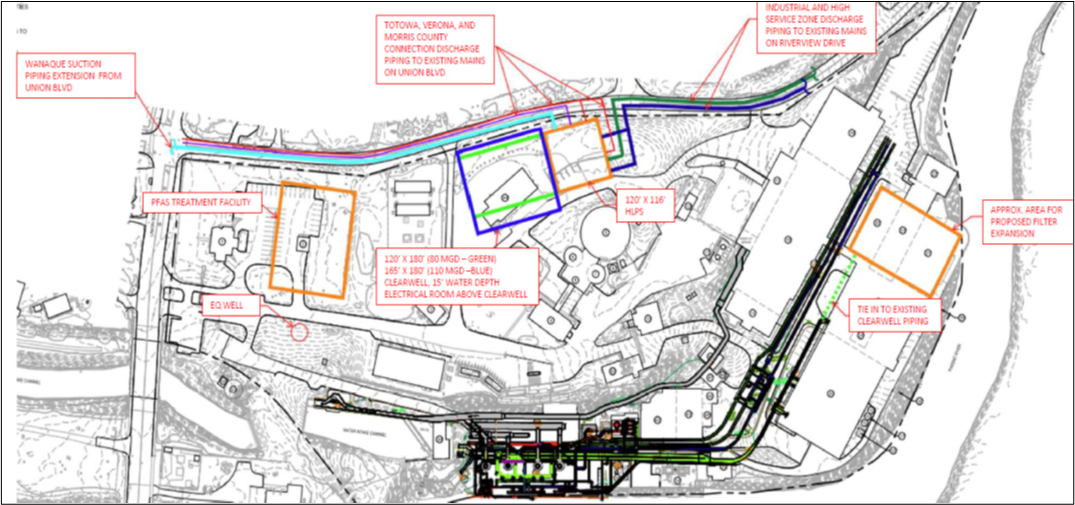
CP map PFAS.png


Currently the compliance sampling period is scheduled to start in 2027 two (2) years ahead of the 2029 compliance date. This schedule does not give PVWC enough time to adopt and implement a treatment strategy to remove PFAS and comply with new limits. The recent Federal proposal to allow an additional two years to the compliance schedule moving it from 2029 to 2031 is extremely helpful. It remains to be seen if the State of New Jersey will adopt a more stringent compliance schedule. This additional time will assist PVWC in further developing alternatives for compliance and initiating upgrades in the next four (4) years with monitoring starting in 2029 ahead of the proposed 2031 date.


A site visit was conducted in October to Cape Fear, NC to walk through their current PFAS technology of post-filter, gravity contactors with GAC. In addition, a prioritization meeting was held in November 2025 with PVWC, Black and Veatch and Arcadis to sort through the competing needs of water storage, PFAS and other state of good repair needs. To maintain a pathway to compliance with the 2031 date, we intend to finalize our plans for PFAS in the first half of 2026 and develop a phasing plan consistent with plant and system priorities as well as funding constraints.


The State of NJ reached a state-wide settlement with 3M, a major manufacturer of PFAS material, for $450M. It remains to be determined what amount, if any, of this settlement will be made available to utilities to assist in funding treatment upgrades to comply with the new compliance targets.


State-of-Good Repair Projects – Construction

Actiflo Rehabilitation ($4.8M across two contracts)

Coppola Services continues work on the Actiflo rehabilitation. Coating operations have commenced on the first Actiflo train, which is anticipated to return to service toward the end of January 2026. Upon completion, the contractor will take the second train offline to begin the next phase of rehabilitation. The overall contract work is scheduled to be completed by Fall of 2026 under the original 2-year contract awarded in September of 2024.

Residuals Facilities Upgrade ($31.2M)

CP residuals facilities upgrade.png

Coppola has begun asbestos remediation within the former Belt Filter Press building. Once remediation is complete, the structure will be demolished to allow construction of the new residuals processing facilities to proceed. Inhouse staff are installing a new water line to the building that is nearing completion so water service can be maintained to other parts of the plant. The work is scheduled to be completed by March 2028.

Filter Valve Replacement Project ($7.9M)

CP filter valve replacement.png

The contractor is progressing with shop drawing submissions and developing sequencing plans to safely isolate filters for valve replacement work. During a recent plant shutdown, Coppola measured the filtered water conduits to support fabrication of new stop logs. The work is scheduled to be completed by September 2027.

State-of-Good-Repair Projects - Design

There are also ongoing designs for upgrades to the liquid oxygen (LOX) system and chemical addition facilities. The influent gates, and influent screens are also being assessed for upgrades. These projects will be prioritized for funding based on risk-based business cases.


Digital Transformation

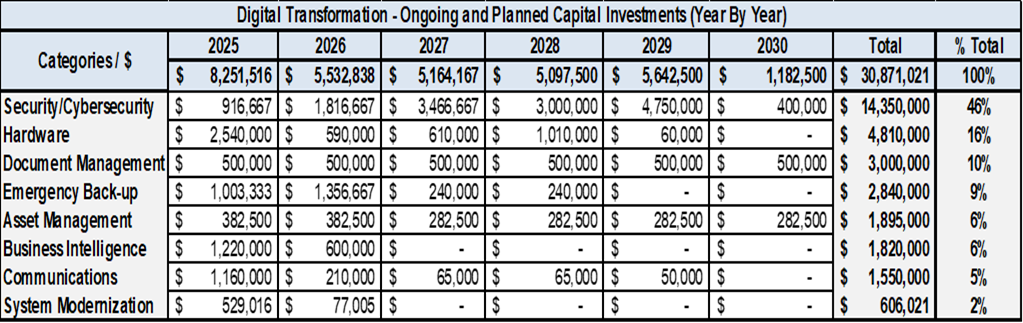
As part of the approved 2025 budget there is $30.9M allocated for capital investment in PVWC digital transformation initiatives between 2025 and 2030 involving both information technology (IT) and operational technology (OT). These investments cross different infrastructure areas of focus with some investments already underway and others ramping up over the next few years. These focus areas are categorized as follows: security/cybersecurity; hardware; document management; emergency back-up; asset management; business intelligence; communications; and system modernization. The table below includes the capital budgeted in each focus are by fiscal year.  
CP digital transformation chart.png


Early priorities in 2025 include modernizing the financial management system (FMS) and fleet monitoring technology; further developing a data governance framework for the new enterprise data warehouse and optimizing CMMS/GIS/CIS for business intelligence; communications improvements for fiber optic cables, cellular systems; telephones and website; and hardware replacement due to antiquated equipment.  In 2026, investments ramp-up for facility access control upgrades for building security as we also prepare plans and designs for a data center to be implemented towards the end of the decade. Steady annual investments are also planned for document management to preserve institutional knowledge and make staff access easier to critical, secure information; as well as improve the inventory and plan for system upgrades for SCADA hardware and software due to equipment modernization needs.


Other Initiatives

Systemwide Valve Exercising Program

A concerted effort has been made to exercise and note deficiencies of all of the valves in the PVWC system. By the end of 2025 our contractor had assessed almost 4,000 valves in the system. Approximately 1/3 of the valves had documented issues that either were addressed in the field or need to be prioritized for inhouse replacement or capital projects.

Transmission Main Acoustic Leak Detection Inspection

CP smart ball.png

After months of preparation for PVWC’s first inspection of a transmission main, including the installation of taps, valve inspections, and flow tests, Pure Technologies completed an internal acoustic leak inspection on June 25th, 2025. We inspected approximately 18,000 LF of the 42” concrete lined, steel pipe using the SmartBall technology.

At a workshop in November, I requested the PVWC engineering team and design consultant teams to develop a toolbox of options for leak detection across the 650-mile-long distribution system. That deliverable is due in February 2026 and based on the options identified we will prioritize next steps on inspections.


Community Engagement

Throughout the year the Executive Director and David Pascrell, Director, Gibbons Law, have been meeting with various elected officials to discuss PVWC accomplishments as well as funding needs. Key topics covered include past due balances and opportunities for customer assistance (e.g. SHARES); and extensive infrastructure needs and funding recommendations including proposed principal forgiveness increases for Tier 1 affordability areas like PVWC. To date we have met with Congresswoman Nellie PouState Senators Paul Sarlo, and Teresa Ruiz; Assemblyman Gary Schaer, 36th District; Assemblywoman Alixon Collazos-Gill 27th District; Assemblywoman Rosaura Bagolie, 27th District; and Assemblyman Clinton Calabrese, 36th District.  In November, Executive Director Mueller was appointed to Governor-Elect Sherrill’s Interdisciplinary Transition Team Advisory Task Force to provide input on policy issues for the incoming administration. Other key meetings and events are summarized below.

  • Eight (8) municipal meetings were held with Clifton, Paterson,  Lodi and North Arlington to discuss paving coordination, LSLR, capital work, illegal hydrant usage and site restorations for street and curb work and on-going and planned work.
  • The annual Consumer Confidence Report (CCR) was issued in compliance with the Safe Drinking Water Act and mailed to all customers. This report highlighted various water quality parameters and PVWC compliance with State and Federal regulations.
  • A PVWC Alerts! was sent out to inform all of PVWC’s customers of our new payment system, Paymentus.
  • February 2025: 1) Met with N. Arlington on water main replacements; 2)  Attended Passaic Council meeting to provide update on LSLR program and other projects.
  •  March 2025:  NJ AWWA State Conference Annual Water Tasting Competition – PVWC was voted the best-tasting water in the State! PVWC staff also were presenters at the conference.
  •  April 2025: 1) Communications personnel presented on the importance of municipal relationships “Beyond the Surface” webinar; 2) Lodi Municipal meeting
  •  May 2025: PVWC personnel attended the Great Falls Education Event
  •  June 2025: Levine Tanks Town Hall
  •  August 2025: The Executive Director attended Senator Benjie Wimberley’s “Barbershop Talk” in Paterson to speak about the August water emergency and listen to forecasts for the upcoming North Jersey High School football season. Go BC Crusaders! 
    CE august.png
  •  September 2025:  1) PVWC received a Historic Preservation Award from the City of Paterson’s Historic Preservation Commission for our rehabilitation of The Pump House, built circa 1895 and the Gate House, built in the early 1900’s. 2) Executive Director attended the Clifton Council Meeting regarding water quality.
    CE september.png
  • CE november.png
    November 2025: PVWC’s team attended the Career Carnival for Kids at the Cliffton Allwood Library.
  •  December 2025: 1) N. Arlington Municipal Meeting; 2) PVWC participated in the Totowa, West Paterson, and Little Falls Fire Department Holiday Parade, earning 2nd place in the “Best Club or Organization” category—an exciting improvement from last year’s third-place finish.


    CE Dec.png   

Media Relations

  • PVWC was mentioned approximately 2,039  times in 2025 (mostly TV and online print).
  • PVWC issued 34 press releases and advisories to keep customers and stakeholders informed about key initiatives, projects, and service updates. Highlights included announcements on the Board reorganization, the launch of PVWC’s new website and payment system, and the Levine Reservoir storage tanks groundbreaking. PVWC also shared updates on annual hydrant flushing, winter weather tips, and its partnership with SHARES to provide water bill assistance; coverage from News12 New Jersey, NBC New York, Fox 5, ABC NY, WMBC, Tap Into Paterson, northjersey.com and NJ.com.
  •  A significant portion of communications—18 releases—focused on the boil water advisory and subsequent updates, ensuring transparency and timely information during the event.
  •  April 2025: Press Conference – PVWC’s partnership with SHARE’s, a municipal customer assistance program designed to provide utility bill assistance to income-qualified households.
  •  June 2025: Levine Storage Tanks Construction Project Press Conference and Groundbreaking Ceremony.

    CE Levine groundbreaking.png
  •  August 2025 – multiple daily press conferences and interviews during the Paterson Water Emergency relaying information on water bottle distribution, repair timeframes and interim measures to restore water service and improve system pressures.

Social Media

  • In Q4 2025, we significantly expanded our social media presence to strengthen engagement and transparency which was very well received by the public, municipalities and Commissioners. This included posting updates when repairs were made on main breaks which the public appreciated.
  • Social media outreach garnered 271 Facebook posts, 258 Instagram posts, 248 X (formally Twitter) posts and 42 LinkedIn post for business-focused updates, totaling 819 social media posts. This figure does not include real-time updates added to existing posts notifying customers when repairs were completed and water service restored.
  •  Social media also served as a channel for holiday hours, employee accomplishments, and team-building moments, creating a more connected and informed audience.
  • We introduced new recurring features such as “#FlashbackFriday,” “#TakeMeBackTuesday,” and “#MidweekMood,” which have generated strong engagement and positive feedback. “Flashback Friday” highlighted historical content dating back to 1886, including posts about the Stanley M. Levine Reservoir and PVWC Board Member Marinus de Nooyer, founder of the Water Works Museum.
  •  PVWC Alerts! continued to expand in 2025, providing timely notifications for main breaks, hydrant flushing, valve work, and payment system maintenance, with 150 alerts issued during the year. This figure does not include the “follow-up” feature, which PVWC sends an additional message confirming that repairs have been completed and water service restored. As of year-end, 10,609 customers were enrolled in PVWC Alerts!, reflecting strong adoption of this important communication tool.


Employee Engagement

Creating engagement opportunities with all staff is a critical focus to assist in communicating the company direction, discuss issues employees are facing, and generate ideas for how to improve the workplace environment and overall efficiency. Throughout 2025, multiple efforts were undertaken for employee engagement including:


Java with Jim

PVWC launched the “Java with Jim” initiative in 2024 to foster open dialogue between the Executive Director and employees. These meetings continued into 2025 as an opportunity to discuss key topics such as the capital program, facility improvements, licensing, and career planning, while reinforcing employees’ pride in serving the community. PVWC is committed to continuing these sessions in the future and has already kicked off 2026 with the first one.


Internal Town Halls & Employee Appreciation Day

There were two (2) meetings held throughout the year with all PVWC staff given an opportunity to attend either in-person or virtually via Teams. One (1) was held in Clifton and Little Falls on April 30th to discuss the status of various company initiatives. The other one (1) was held December 16th in Clifton and Little Falls covering a variety of topics including: healthcare/insurance, our new Wellness and Socials committee and providing an overall up on PVWC’s Capital and Operational initiatives. Additionally, on March 7th, PVWC celebrated Employee Appreciation Day with a “Cup of Gratitude” event at both Clifton and Little Falls locations to recognize the hard work and dedication of our employees.


Employee Training and Professional Development

In 2025, approximately 50 PVWC employees participated in 32 different trainings, seminars, and conferences to strengthen technical expertise, leadership skills, and regulatory compliance. These included advanced courses in water treatment and operations, GIS for asset management, microbiology, and water and wastewater chemistry. Specialized training covered HAZWOPER refresher, OSHA courses, trenchless rehabilitation technology, and fraud investigation. Staff also engaged in leadership programs such as the Pathways for Aspiring Leaders series, HR initiatives, and purchasing association workshops. Industry conferences and meetings—such as AWWA events, NJ Water Association, NJ League of Municipalities, and ESRI User Conference—provided valuable networking and knowledge-sharing opportunities. Many of these classes were also essential for maintaining professional licenses and certifications, ensuring PVWC employees remain qualified and compliant with regulatory standards. These trainings resulted in employees earning Continuing Education Units (CEUs), Continuing Legal Education credits (CLEs), certifications, and Public Health (PH) credits, reinforcing PVWC’s commitment to operational excellence and workforce development.


Management Meetings with the Union Staff

PVWC conducts two types of quarterly meetings with union representatives, scheduled on a staggered basis throughout the year: 1) Labor Management Meeting; and 2) Safety Committee Meeting

  1. Labor Management Meeting: The Executive Director, Director of ODHR, department heads and legal counsel as needed, along with the Communications Workers of America (CWA) representative and PVWC union shop stewards meet periodically. Three (3) of these meetings were held in 2025 and key issues discussed include: employee-related issues including COVID payouts and clarification of policies for personal days and floating holidays; disciplinary hearings; scheduling new hire orientations; FMLA procedures and operational concerns.  Additional topics included health insurance responsibilities during unpaid leave, time-off request challenges within departments were addressed and handling employee write-ups to maintain compliance and accountability.


  2. Safety Committee Meeting, attended by the Executive Director, staff from the EHS department, department heads, union shop stewards, and other staff as needed, with four (4) meetings held in 2025. Safety meetings addressed a broad range of topics, including proper rain gear for distribution crews, contractor safety requirements, improved collaboration between contractors and operations, and enhanced containment in the dry polymer room to prevent spills. Additional discussions covered site security, autoclave ventilation improvements, safe handling of heavy gas tanks in the lab, seasonal safety reminders, ergonomic equipment procedures, and a review of common PEOSH citations. All issues are documented in an action list and reviewed at subsequent meetings to ensure timely resolution.


Contract Negotiations

 With the current contract approaching its expiration, PVWC and union representatives have held one (1) negotiation meeting in December 2025 and two (2) in January 2026. Several additional sessions already scheduled for January 2026 to continue discussions.


Field Tours

Beginning in September 2024, the Executive Director launched a field tour initiative to showcase the outstanding work performed by field staff and increase transparency across the organization.  The tours highlight key accomplishments, identify opportunities for improvement, and strengthen collaboration between teams. In 2025, the initiative continued with visits to the Maintenance team at Little Falls, the Excavator crew, and the Electrical group, reinforcing the company’s commitment to recognizing operational excellence and fostering continuous improvement. More to come in 2026!

EE apr july nov.png


Employees-All Emails

In 2025, the Executive Director maintained consistent communication with employees, sending out 68 emails that provided updates on organizational progress, safety initiatives, and community engagement. Monthly Executive Director Reports kept staff informed of key developments, while Town Hall sessions and holiday events fostered transparency and connection. Employee engagement was further supported through programs such as Take Your Children to Work Day, field tours, and the Point View Fishing Program. Safety remained a top priority with monthly safety topics, cybersecurity alerts, and maintenance notices. The Executive Director also communicated critical information during emergencies, including major water main breaks and state-of-emergency responses, ensuring operational continuity. Additional messages highlighted cultural observances, shared media coverage of PVWC’s efforts, and announced participation in industry events. Personnel updates and grief support services reflected a commitment to employee well-being, underscoring PVWC’s dedication to both its workforce and the communities it serves.

Employee Assistance Program (EAP)/Emme Experience

EAP emme.png

There were multiple Employee Assistance Program sessions on site throughout 2025 to provide grief counseling for staff affected by the deaths of colleagues throughout the year. For some of these sessions there was a dog named “Emme” who was brought in to connect with staff and provide comfort. She was well liked and will be coming back to visit during 2026 by popular demand.


Company Demographics

As of December 31st there were 247 full-time employees working for PVWC – 170 (69%) of these employees worked in blue collar/operational positions in Distribution, Laboratory, Maintenance, Pumping and Purification. The other 77 (31%) employees worked in administrative and/or professional positions in Customer Service, EH&S, Engineering, Executive, Finance, Information Technology, Legal, Personnel and Purchasing.  

EE staff breakdown chart.png


An analysis of the company demographics was first completed in October 2024 including ethnicity, years of service, new hires, promotions, and departmental staff distribution. This analysis is in the process of being updated and a tabular summary of company demographics  as of the end of 2025  is provided in the table on the left. The approach to hiring is a committee-based, interview framework focused on skills and qualifications to select the best candidates for each job. Demographics continue to change over time as people retire and new hires sourced from the local population in a fair and balanced manner start working. At the end of 2025, there were 108 employees who live in the Main System (Paterson, Clifton, Passaic and Prospect Park) which represents 44% of the company.  There were 165 employees who live in Passaic County which represents 67% of the company.

EE Admin demographics.png

In 2025 there were 16 separations – 9 were retirements and four (4) voluntary resignations. In addition, we grieved the passing of three (3) colleagues:

  • Howard Tribucher, Water Repairer 2, passed away in February 2025. Howard was a loyal staff member of PVWC for over 35 years, starting his career in 1989.
  • Ron Meola, Assistant Maintenance Supervisor, passed away in September 2025.  In the 10 short years he was here he made a lasting impact on many colleagues.
  • Lee-Roy Jones, Water Meter Repairer, passed away in November 2025. He was a great friend to many and helped those in need.


Each will be missed by his friends and colleagues throughout the company – RIP Gentlemen.


Performance Management

The performance management process is a key tool in creating transparency, fostering continuous improvement, and investing time and effort into people. The Executive Office, working with ODHR, spearheaded the rollout of quarterly performance evaluations company-wide for the first time in over 30 years. ODHR has taken over the entire process in 2025 and it has moved to an annual frequency. Evaluations are due in January 2026 and will be used to further recognize and document good work, best practices and guide future training opportunities. In addition, performance assessments will help identify workload, staffing and skills gaps that are a key input to succession planning needs across departments. ODHR will be working closely with each department in 2026 to further solidify succession plans.


Optimizing Operations

PVWC continues to evolve in its data-driven approach to develop a culture of continuous improvement. The Power BI data dashboards that started initially rolling out in November 2024 continued to roll out in 2025 across the following four (4) departments: Customer Service; Laboratory; Purification and Distribution. This effort integrated data from two main systems: 1) Laboratory Information Management System (LIMS); and 2) Customer Information System (CIS) that are applicable to these departments.  These dashboards continue to be updated daily with minimal consultant support although optimization of the dashboards requires data scientists to further leverage valuable business information across PVWC departments. Key departments to advance next are Purchasing, and Customer Service to incorporate the phone system information.

In January 2025, the Executive Office compiled a preliminary list of other systems utilized across all departments that will be incorporated into the Power Bi dashboards in phases. There are over 60 source datasets/systems identified. During the Spring of 2025, a series of meetings was held by the Executive Director with the Director of IT and the Chief Engineer of Planning and Modeling to build consensus on the following: 1) next steps for the development of a data warehouse and concurrent development of additional dashboards; 2) improving GIS capability, and 3) streamlining our protocols and capability to share key data securely while maximizing the efficiency of having consultants work remotely.  The consulting firm Ernst and Young was identified by IT to assist with assessing the current data infrastructure and governance. Their recommendations have been reviewed with the Department Heads and the Executive Director. The Executive Director has requested that IT develop a project management plan identifying next steps regarding data governance and concurrent rollout out of additional dashboards.  Below is a summary of key information for each department for 2025.

Customer Service: In 2025 the Customer Service Department fielded 98,327 calls – almost 83,000 (84%) were English speaking and over 15,000 (16%) were Spanish speaking callers.  Almost 82,000 of the calls were logged in terms type (e.g. pay bill, complaint etc). which is 83%. This is an increase from 2024 where it was 80% logged. Call volume was up by over 3% compared to 2024 predominantly because of the August Paterson water emergency as well as the rollout of the new payment system in late September.  

PM customer contact volume.png


Dashboard: Total Complaint-Based Logged/Categorized Calls in 2025

PM customer contact dashboard.png

There were 8,510 logged complaints in 2025 with the highest month being August due to the water emergency. In May, Customer Service experienced a high rate of “dead line calls” which was rectified by IT and the phone provider. Billing complaints increased due to the learning curve for many customers attempting to navigate the new payment system starting in October through the end of the year

Laboratory

Dashboard: Free Chlorine  in 2025:

PM free cholorine.png

In 2025 there were 5,788 free chlorine samples collected by PVWC water sample collectors regularly at various locations throughout the entire retail system and processed by the laboratory. This water quality parameter measures how chlorine remains available in the water distributed to customers to maintain the ability to kill pathogens and microorganisms throughout the water distribution system. 

Currently, the NJDEP mandates that a minimum free chlorine concentration level of 0.2 mg/l is maintained in all parts of the distribution system to ensure protection of public health. Based on the new NJ Legionnaires’ Disease Law effective September 12, 2024 a new minimum of 0.3 mg/l has been established with NJDEP and DOH expected to release best practices for water systems by September 2025. Water utilities will have six (6) months from that date, anticipated by March 2026, to implement these best practices as part of a water management plan and submit an annual certification to DEP.  In recognition of this new mandate, PVWC has begun to assess locations against both the 0.2 mg/l and 0.3 mg/l free chlorine concentration levels. In 2025 there were 213 samples (3.7%) with free chlorine less than 0.3 mg/l and 144 samples (2.4%) were less than 0.2 mg/l. There were five (5) positive coliform tests and local hydrant flushing was performed and retesting to ensure protection of public health. as well as revisiting sampling protocols to ensure the line is flushed and is representative of water in the main. The maximum concentration was 3.92 mg/l, below the mandated maximum of 4 mg/l.

Dashboard: Disinfection Byproducts  in 2025:

PM disinfection byproducts.png

Another key water quality parameter regularly sampled by PVWC water sample collectors is disinfection byproducts (DBPs) with regulated amounts for total trihalomethane (TTHM) not to exceed 80 ug/l and for haloacetic acid (HAA) not to exceed 60 ug/l as a running 4-quarter average due to linkages to increased cancer risk with long-term exposure. There were 85 samples taken for TTHM in the retail system in 2025 with two locations with one sample exceeding the maximum amount in August. The 4-quarter average was well below 80 ug/l. There were 85 samples taken in 2025 for HAA with none exceeding the maximum amount. The ozone treatment process used by PVWC is the main reason for 100% compliance due to the destruction of raw water organic material that can lead to DBPs when mixed with chlorine.

Distribution and Maintenance:

PM service order volume.png

Power BI dashboards were rolled out for Distribution department in Spring 2025 capturing work orders programmed through the CIS system mainly related to meter readings and past-due-balances.  Much of these work orders have historically been related to meter readings through the third-party contract. While PVWC’s intention was to continue to third party contract for the next two years until the meter replacement contracts had been implemented making the work less laborious for in house staff, lack of interest in contractors to continue to perform the work forced the contract to end in July. Inhouse staff have been taking on meter readings since that time and estimated readings have spiked to due to the increase in workload volume. We will continue to look to add meter reading staff in 2026 to address the issue.

PM monthly distribution metrics.png


Annual hydrant flushing began to ramp up in March, however due to the transmission main breaks in Paterson in August and September, flushing production was impacted. Resources were redeployed to flush the entire Paterson and Prospect Park systems to clear the boil water advisory in early September. Almost 4% of the hydrants required repairs mainly due to vehicular impact and 30 hydrants were replaced.

There were 155 water main breaks in 2025 with inhouse staff addressing over 90% of the locations. Contractor staff are called in if it is an extremely complex situation (e.g. the August and September transmission main breaks in Paterson and Woodland Park) or if in-house crews cannot keep up with a high volume of concurrent breaks. As the Distribution department has staffed up, more work has been insourced, as warranted.  Over 70% of the breaks occurred during the cold weather months due to low temperatures causing the ground to expand and metal pipes to contract increasing the pressure on old pipes by a factor of 10 times normal. During warmer months there are some spikes observed in water main breaks mainly due to illegal hydrant usage associated with paving activities or authorized hydrant usage during street sweeping or fire emergencies that can cause breaks if the hydrants are not carefully shutdown after use. The average industry metric is 20-30 breaks/100 miles. In 2025 PVWC had 23.8 breaks/100 miles which tracks closely to the industry average. It is a significant increase over 2024 due to extreme cold weather as well as changes to the operation of the Levine system due to reservoir being out of service for construction activities necessitating a change in operation to that system. December 2025 saw a 72% increase in the number of water main breaks compared to December 2024.  

There are approximately 65,000 curb boxes on PVWC customer service lines that are used to isolate localized areas in the event of emergencies for water main breaks or fires; or for chronic delinquent account shutoffs and abandoned properties. Many of these boxes have been buried over the years through paving activities or other construction and are required to be excavated to function properly. In 2024 inhouse crews excavated 988 curb boxes to support fire departments and ongoing PVWC operations. 

There were almost 20,000 mark outs of PVWC underground infrastructure performed by Distribution staff to support local development and street construction as well as protect PVWC assets. Almost 1,600 (8%) of these mark outs were due to emergency work requiring a 4-hour response time. The remaining 18,400 regular mark outs require a PVWC response within three (3) business days. The high volume of work, short response times, and weather impacts make this a challenging operation that generates a lot of overtime.  There were also over 3,700 meter changes performed by staff in 2025 which is 5.4% of the system-wide meters. At this annual production, the lifecycle of meters would be on the order of 20-25 years and many existing meters are already 10-20 years old. PVWC awarded two (2) meter replacement contracts in late 2024 to catch-up with older meter replacements as well as take advantage of principal loan forgiveness currently  available through the State Intended Use Plan (IUP) estimated at $7M/year.

Finally, the Maintenance department initiated over 1,600 work orders for preventative and corrective maintenance in 2025 and completed over 1,500 (93.8%). With the ongoing implementation of a new Computerized Maintenance Management System (CMMS) additional preventative maintenance work orders are being programmed to consolidate activities under Maintenance that were previously performed by other departments. Starting in June 2025, the Executive Director has been meeting on a quarterly basis with Maintenance, Pumping and Purification departments to review work order production and discuss issues impacting operations. Optimizing the existing CMMS program is a goal that Javier Hendricks in Engineering is supporting along with Pat Porcaro.

Purification: PVWC continued to provide high-quality water in compliance with State and Federal regulations to all customers in 2025. Data dashboards rolled out to Purification in 2025 and are still being tweaked.

One issue that can occur during the summer as referenced in the Customer Service section, is the spike in complaints regarding a “musty” or “earthy” water taste in some areas. MIB and geosmin are naturally occurring compounds in source surface water that have an earthy taste and odor. During warmer months PVWC can experience higher concentrations in our mixed-supply, post-treatment due to the water provided by the Wanaque filtration plant. That plant does not have granular activated carbon and instead relies on treatment with PACL to remove suspended solids and turbidity. Due to above normal temperatures and drought conditions the high concentrations can last for several months causing a spike in taste, odor and color complaints. Since late October 2024 concentrations have trended down although some increased levels have been observed during Summer 2025. PVWC staff had been meeting with NJ American Water and NJDWSC staff to discuss ways to mitigate the situation.

PM mixed MIB.png


Another impact from the unusually dry summer is the raw water quality in the Passaic River at the intake of the Little Falls treatment plant.  The unusually low flow conditions result in more of the river water being generated by upstream wastewater discharges. This requires an increase in chemical dosages at the plant to remove higher solids which also increase sludge production and adds cost. This is something PVWC operations staff monitor closely and adjust chemicals and sludge hauling in real-time as warranted. Chemical costs are the largest operational expense at the treatment plant totaling $9.5M in 2025 followed by sludge removal totaling $5M. Both costs are up from 2024 due to consumption and new contract costs.

PM charts.png


Pumping and Power: The Executive office is still in the process of developing data dashboards for this department similar to what has been done for Customer Service and the Laboratory. The dashboards are expected to be rolled out as part of a next phase of development. Until these dashboards are available we have been gathering data each month in spreadsheets to give insight into workload and performance. The tabulated metrics for 2025 are presented below with a narrative summary.

PM monthly pumping and power.png

There were 600 MG of interconnection flows made in 2024. About 40% of the annual flow was provided by Wanaque and 60% by PVWC which is atypical due to dry weather conditions, infrastructure failures and treatment plant operational issues on the NJDWSC end. In addition, certain components of the PVWC Main Pumping Station (PS) are nearing 125 years old, and we will be developing a plan for a replacement pumping station in the next few years.

 Engineering: Given the scale of the capital program, it is important that vacancies in Engineering are filled expeditiously to handle the volume of work. While 2025 was challenging in filling vacancies, the 2026 strategy is to hire a cohort of 4-6 entry level college graduates to fill critical needs and groom them to the PVWC capital program as long-term stability. There are several vacancies for senior positions as well and these will still be pursued strategically if qualified candidates are interested.

Information TechnologyAs mentioned previously, IT is spearheading the digital transformation of PVWC at the direction and with the support of the Executive Director.  Staffing the IT department remains a priority and vacancies should be aggressively filled when qualified candidates become available.  In the meantime, consultant support will fill necessary gaps so our program can continue to evolve and meet the needs of a modernizing water utility. Project Management plans will be pulled together by IT staff with the help of support consultants as needed to begin executing a data governance framework concurrent with continued rollout of business intelligence dashboards.

Purchasing: The internal PVWC procurement process is a centralized model with the Purchasing department controlling the entire process. Each department now supplies subject matter experts to have input on technical specifications and scopes of work and to participate on selection committees for professional services and competitive proposals. Concurrent with this change we have modified our scopes of work for consultant solicitations and introduced a more rigorous evaluation process to ensure equity. In addition, formal vendor and consultant performance evaluations have been ongoing to document good work and identify areas requiring improvement. All these organizational changes were needed to ramp up for the sharp increase in the capital program due to regulatory requirements and the age and condition of PVWC’s infrastructure. Purchasing tracks changing State rules and DCA requirements governing purchasing activities including conflict of interest; and small- or minority owned-business outreach. The department is in the process of onboarding an e-bidding system in 2026. The next phase of data dashboards should assist with the development and reporting of Purchasing metrics.

Organizational Development and Human Resources (ODHR): The goal for ODHR is to collaboratively develop PVWC as a modern water utility providing high levels of service by attracting, developing and retaining talent throughout the organization. PVWC has expanded full-time headcount from 210 in 2022 to 247 by the end of 2025. Supporting each department in filling vacancies as well as filling their own is a priority. Also, supporting each department is succession planning and career pathway development is another priority. ODHR is planning to evaluate new payroll systems to make the process easier - it is currently very laborious.

Finance: In 2025, Finance, in collaboration with Customer Service and IT has implemented a new payment processing system. The implementation has been a learning curve for customers and staff and 2026 should be a smoother time as people get used to the new system. Oracle was selected as the vendor to upgrade the existing antiquated financial management system which is ongoing in 2026. Successful implementation will allow for much easier access to financial information along with dashboards for critical metrics on a regular basis. 

Executive: In 2026 the PVWC Strategic Plan will be updated to highlight what has been accomplished over the last 3-4 years and reenvision the next five (5) years based on practical realities and challenges. The Executive Director has solicited the support of Maria Malfa, Customer Service department head, in this effort who will work with existing Executive staff and each department to update the plans. Maria will also be facilitating the data governance effort with IT and other departments.


2023 - 2027 Strategic Plan: Mission, Vision, Core Values

Passaic Valley Water Commission

2023- 2027 Strategic Plan: Mission, Vision, Core Values


Mission

Safely and efficiently, maintain and distribute a secure and sustainable supply of high-quality drinking water as public stewards of health and safety, community well-being and economic growth for existing and future generations.

Vision

Be an industry leader in developing and applying best practices in all facets of customer service, communications, operations, and administration through a culture of continuous improvement, transparency and transformative organizational investments in people, infrastructure, and systems.

Core Values

Safety: We operate in a healthy, safe and environmentally responsible manner.

Excellence: We strive to be the best in everything we do.

Teamwork: We collaborate, support and trust each other for mutual betterment and optimal effectiveness.

Respect: We accept each other’s differences and perspectives and recognize how they can make us better.

Commitment: We dedicate our time and energy to overcome challenges to get the job done.

Integrity: We stay true to our responsibilities and pledge to do what is best to advance our mission.

Accountability: We are relied upon and held responsible to perform our work safely, effectively and efficiently.

Intelligence: We seek to acquire knowledge and skills to improve overall work performance.

Diversity: We are proud of our various backgrounds and experience; through equity and inclusion we accelerate creativity and innovation.


Diversity is inherent in the wide variety of work we do, the challenges we face, and the broad range of skills needed to succeed every day. Diversity is also represented in our gender, ethnic backgrounds, experiences, characteristics and beliefs that shape who each of us are.


Diversity is our Foundation

that all other core values are built upon.


Diversity enhances intelligence.

Intelligence fosters accountability.

Accountability builds  integrity.

Integrity promotes commitment.

Commitment earns respect.

Respect strengthens teamwork.

Teamwork drives excellence.

Excellence ensures safety.


Living these core values transforms our mission and vision into reality.